
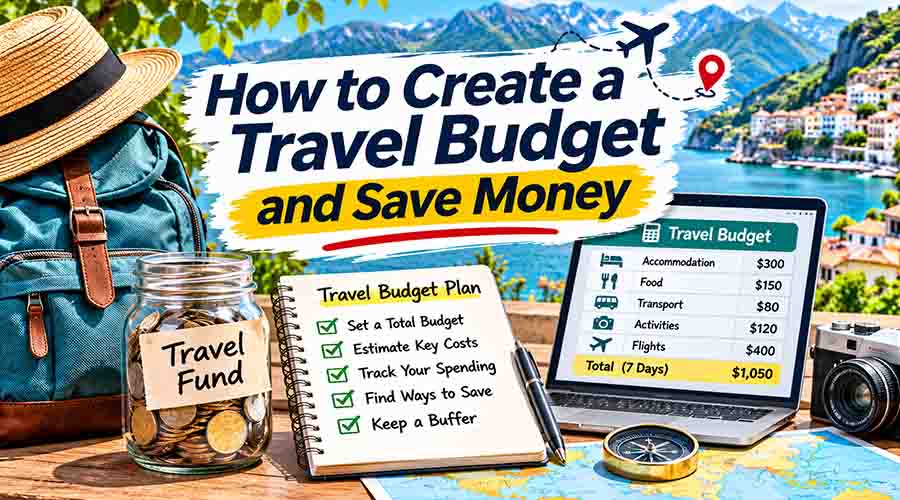
How to Create a Travel Budget and Save Money: A Step-by-Step Guide
Most travel money problems start before the trip, not during it. A flight looks affordable until you add bags and seat fees. A hotel looks cheap until the resort fee and city tax appear at checkout. Then come the card fees, airport taxis and “just one more” activity, and by day four you’re checking your bank balance nervously.
A travel budget fixes that. It shows what your trip will really cost, tells you how much to save and by when, and gives you a daily limit so you can enjoy your trip without guessing. This guide walks you through building a travel budget step by step, with a simple formula, a worked example and a savings plan, then shows you how to cut costs on flights, accommodation, food, transport, activities and fees.
How Do You Create a Travel Budget?
To create a travel budget:
- Set your total spending limit based on what you can afford.
- List every cost category, including hidden costs.
- Research real prices for your destination and travel dates.
- Calculate your total: fixed costs + (daily costs × number of days) + a 10–15% buffer.
- Set a daily spending limit and track it during the trip.
- Build a savings plan by dividing your total by the months until you travel.
- Protect your budget with travel insurance and an emergency backup.
You can do the calculation in minutes with the free Travluno Trip Cost Calculator.
What Is a Travel Budget?
A travel budget is a plan for how much your trip will cost and how you’ll pay for it. It covers every expense: transport, accommodation, food, activities, documents, insurance and extras. It also includes a buffer for surprises and a daily spending limit for the trip itself.
A good travel budget does three jobs:
- Before booking: it tells you which destinations, dates and travel styles you can afford.
- Before departure: it sets a savings target and a timeline.
- During the trip: it gives you a daily limit, so you know when you can splurge and when to hold back.
Step 1: Set Your Total Spending Limit
Start with what you can afford, not with what the trip “should” cost. Look at your savings and monthly income, and decide on a maximum you’re comfortable spending without borrowing or using money set aside for essentials and emergencies.
This number shapes every other decision. A fixed limit lets you compare options honestly. For example, you might choose a shorter trip somewhere expensive, or a longer trip somewhere cheaper.
Tip: If the trip you want costs more than your limit, adjust one of three things: the destination, the trip length or the travel style. Changing any one of them can lower the cost significantly.
Step 2: List Every Cost Category
Split costs into fixed costs, which you pay once and often in advance, and daily costs, which you pay every day of the trip.
| Fixed Costs (Pay Once) | Daily Costs (Pay Per Day) |
|---|---|
| Flights or long-distance transport | Food and drinks |
| Accommodation (total for all nights) | Local transport (metro, bus, taxis, ride-hailing) |
| Visa and passport fees | Activities and entrance fees |
| Travel insurance | Tips |
| Airport transfers | Small purchases and snacks |
| Pre-booked tours and tickets | Mobile data top-ups |
| Vaccinations and travel health costs | Laundry and incidentals |
| Gear you need to buy (adapter, luggage) | Souvenirs and shopping |
Hidden Costs Most Travelers Forget
| Hidden Cost | Where It Appears |
|---|---|
| Checked baggage and seat selection fees | Especially on budget airlines |
| Resort fees and city or tourist taxes | Added at check-in or checkout in some destinations |
| Airport transfers | Late arrivals, remote airports |
| Card and ATM fees | Every overseas card payment or cash withdrawal |
| Unfavorable currency conversion | Card machines, ATMs and exchange counters |
| SIM card or eSIM | International trips |
| Tips and service charges | Restaurants, guides, drivers |
| Security deposits | Hotels, rentals and car hire |
| Visa or entry fees | Many international destinations |
| Travel insurance | Often left out until the last minute |
Step 3: Research Real Prices
Estimates based on guesses are the main reason budgets fail. Spend an hour researching real prices for your dates:
- Flights: check prices on a flight search tool for your exact dates, plus a few days either side.
- Accommodation: look at the actual nightly price, including taxes and fees, for the areas you’d like to stay in.
- Daily costs: check typical meal prices, transport fares and entry fees in recent destination guides, official tourism sites and traveler forums.
Travluno’s destination guides and things to do pages are good starting points. For up-to-date local prices, ask travelers who’ve just been on the Travluno Travel Forum.
Step 4: Calculate Your Total Travel Budget
Use this simple formula:
Total travel budget = Fixed costs + (Daily costs × number of days) + buffer (10–15%)
Worked Example: 7-Day Trip for Two People
These figures are for illustration only. Use real prices for your own trip.
| Item | Calculation | Cost (USD) |
|---|---|---|
| Return flights | 2 × $550 | $1,100 |
| Accommodation | 6 nights × $60 | $360 |
| Travel insurance | 2 people | $80 |
| Visa fees | Not required in this example | $0 |
| Airport transfers | Return | $40 |
| Fixed costs total | $1,580 | |
| Food (for two) | $40 per day | |
| Local transport | $15 per day | |
| Activities | $25 per day | |
| Extras | $10 per day | |
| Daily costs | $90 × 7 days | $630 |
| Subtotal | $1,580 + $630 | $2,210 |
| Buffer (10%) | $221 | |
| Total travel budget | $2,431 | |
| Per person | about $1,216 |
From this, your daily spending limit on the ground is $90 for two people. That’s the number to track during the trip.
Step 5: Set a Daily Spending Limit and Track It
Your daily limit covers costs on the ground: food, local transport, activities and extras. Track spending each evening using a notes app, a spreadsheet or a budgeting app. It takes two minutes and makes it easy to correct course early.
How to manage your daily limit:
- Balance expensive and cheap days. A costly excursion one day can be offset by a free beach or park day the next.
- Keep a running total, not just a daily figure. Being $10 under on Monday gives you $10 extra on Tuesday.
- Review halfway through the trip. If you’re over budget, cut back on extras rather than skipping the experiences you came for.
- Keep the buffer for real emergencies. It isn’t extra spending money.
Step 6: Build a Travel Savings Plan
Once you know your total, turn it into a monthly savings target:
Monthly savings = Total travel budget ÷ months until departure
Using the example above ($2,431 total):
| Time Until Departure | Save Per Month | Save Per Week |
|---|---|---|
| 6 months | about $405 | about $94 |
| 10 months | about $243 | about $56 |
| 12 months | about $203 | about $47 |
Practical Ways to Save for a Trip
- Open a separate savings account for the trip so the money isn’t spent by accident.
- Set up an automatic transfer on payday. Money you don’t see is easier to save.
- Cut one or two regular expenses temporarily, such as unused subscriptions, takeaway meals or impulse shopping, and redirect the money.
- Save extra income, such as bonuses, gifts and freelance or overtime pay.
- Pay for big items early. Booking flights or accommodation in advance spreads the cost and can secure lower prices.
- Track your progress monthly so you can adjust your timeline or trip plan.
Step 7: Protect Your Budget
- Buy travel insurance. Medical care and medical evacuation abroad can be very expensive, and many health insurance plans don’t cover overseas care. Include insurance in your budget from the start, not as an extra.
- Choose flexible bookings where possible. Free-cancellation rooms cost a little more but can save you a lot if plans change.
- Carry a backup payment method, such as a second card stored separately, in case one is lost, blocked or stolen.
- Keep your buffer separate from your daily spending money.
How to Save Money on Flights
Flights are often the biggest single cost of a trip, so small changes make a big difference.
- Book in the right window. Google’s analysis of five years of Google Flights data found that domestic US fares were cheapest on average about 39 days before departure. International fares were cheapest about 89 days out, with prices staying low from roughly 50 to 133 days before departure. Routes vary, so treat this as a guide.
- Ignore the “book on Tuesday” myth. Google’s data found the day of the week you book makes very little difference.
- Be flexible with dates and airports. Shifting by a day or two, or flying into a nearby airport, can lower fares noticeably.
- Set price alerts instead of checking every day.
- Compare the total price. A cheap fare with paid bags and seats can cost more than a full-service fare.
- Travel carry-on only when you can, to avoid checked baggage fees.
- Fly in the shoulder season, just before or after peak season.
How to Save Money on Accommodation
- Prioritize location. A slightly pricier room near the sights or public transport can save money and time every day.
- Consider guesthouses, homestays, hostels’ private rooms or apartments. They’re often better value than hotels, and apartments let you cook some meals.
- Look for weekly or long-stay discounts if you’re staying a week or more.
- Check the final price, including taxes, cleaning fees and resort fees, before comparing.
- Book free-cancellation rates, then recheck prices closer to your trip. If the price drops, you can rebook.
- Choose breakfast-included rates when they cost less than eating out each morning.
How to Save Money on Food
- Eat where locals eat. Street food, markets and local cafés often cost much less than tourist-area restaurants.
- Make lunch your main meal. Many restaurants offer set-lunch menus that are cheaper than dinner.
- Shop at supermarkets and markets for snacks, fruit and breakfast.
- Carry a refillable water bottle where tap water is safe, or buy large bottles instead of single ones.
- Limit drinks out. Alcohol and specialty coffees add up quickly.
How to Save Money on Transport and Activities
- Use public transport, and check for day passes or multi-day travel cards.
- Take overnight buses or trains on longer routes to save a night’s accommodation.
- Walk. It’s free, and it’s often the best way to see a city.
- Join free walking tours, where available, and tip your guide.
- Look for free attractions such as parks, beaches, viewpoints, markets, temples and free museum days.
- Buy city passes only if you’ll use them. Add up the individual entry prices first.
- Use ride-hailing apps where available, so prices are clear before you ride.
How to Save Money on Currency and Card Fees
Fees are the “invisible” part of a travel budget. They rarely appear in planning but add up across a trip.
- Use a card with no foreign transaction fees. Many standard cards charge a foreign transaction fee of about 1–3% on every purchase made abroad.
- Always pay in the local currency. When a card machine or ATM asks whether to charge you in your home currency, choose the local currency. Paying in your home currency triggers dynamic currency conversion, and the European consumer organization BEUC says that rate is almost always worse than your card provider’s.
- Avoid exchanging money at the airport and avoid topping up at the last minute. Rates are often poorer.
- Make fewer, larger ATM withdrawals to reduce per-withdrawal fees, and use bank-affiliated ATMs where possible.
- Carry a little local cash for small vendors, transport and tips.
Budget by Travel Style
Your travel style has a bigger effect on cost than almost any other choice. Mixing styles is often the best value: save on some things and spend on what matters to you.
| Expense | Budget Style | Mid-Range Style | Comfort Style |
|---|---|---|---|
| Accommodation | Hostels, guesthouses, homestays | 3-star hotels, apartments | 4–5 star hotels, resorts |
| Food | Street food, markets, self-catering | Local restaurants, some cafés | Restaurants for most meals |
| Transport | Public transport, overnight buses | Mix of public transport and taxis | Private transfers, domestic flights |
| Activities | Free sights, self-guided | A few paid tours | Guided and private experiences |
| Best for | Long trips, students, solo travelers | Most couples and families | Short trips, special occasions |
If you’re flexible about where to go, choosing a destination with low daily costs is one of the easiest ways to stretch a budget.
Common Travel Budget Mistakes
- Budgeting only for flights and accommodation. Daily costs often add up to more than you expect.
- Forgetting hidden costs such as bags, taxes, fees and transfers.
- Skipping the buffer. Surprises happen on almost every trip.
- Guessing prices instead of researching them for your dates.
- Not tracking spending until the end of the trip.
- Paying in your home currency at card machines and ATMs abroad.
- Leaving travel insurance out of the budget.
- Spending the buffer on extras instead of saving it for emergencies.
Travel Budget Checklist
- Total spending limit set
- All fixed costs listed and priced
- Daily costs researched for your destination
- Hidden costs added (bags, taxes, transfers, fees)
- Total calculated with a 10–15% buffer
- Daily spending limit set
- Monthly savings target set and automated
- Separate savings account opened
- Travel insurance included
- Card with low or no foreign transaction fees ready
- Backup card and some local cash arranged
- Spending-tracking method chosen
Frequently Asked Questions
How do I create a travel budget?
Decide your total spending limit, list every cost category, and research real prices for your destination and dates. Add your fixed costs, such as flights and accommodation, to your daily costs multiplied by the number of days. Then add a 10–15% buffer and set a daily spending limit to track during the trip.
How much should I budget for a trip?
It depends on your destination, season, trip length and travel style. Add transport, accommodation, food, local transport, activities, visas, insurance and extras, then add a buffer of about 10–15% for unexpected costs.
What is a good daily budget for travel?
A good daily budget covers your meals, local transport, activities and small extras at your chosen travel style. Research typical prices at your destination, set a realistic daily limit, and track your spending each day so you can adjust early.
How can I save money for a trip?
Set a savings target and a deadline, divide the target by the number of months until you travel, and automatically transfer that amount into a separate savings account each month. Cutting a few regular expenses and saving any extra income can help you reach your goal faster.
What is the cheapest way to pay when traveling abroad?
For many travelers, a card with no foreign transaction fees is one of the cheapest ways to pay. Always choose to pay in the local currency rather than your home currency, avoid exchanging money at the airport, and make fewer, larger ATM withdrawals to reduce fees.
Should I include travel insurance in my travel budget?
Yes. Travel insurance is a real trip cost and belongs in your budget from the start, especially for international travel, where medical care and evacuation abroad can be very expensive.
What hidden costs should I include in a travel budget?
Common hidden costs include checked baggage and seat selection fees, airport transfers, visa fees, tourist or city taxes, resort fees, tips, SIM or data plans, ATM and card fees, and travel insurance.
Conclusion: A Good Budget Makes the Trip Better, Not Smaller
A travel budget isn’t about restricting your trip. It’s about knowing what you can afford, so you can spend confidently on the things that matter and cut back on the things that don’t. Set a limit, list every cost, research real prices, add a buffer, save steadily, and watch out for the small fees that quietly add up abroad.
Ready to build yours? Calculate your total and per-day costs in minutes with the free Trip Cost Calculator, plan each day around your budget with our travel itinerary template, and pack smart with the Ultimate Travel Packing List so you don’t pay for things you forgot.

Travluno
Travluno shares practical travel guides, destination ideas and tips to help travelers explore with confidence.