
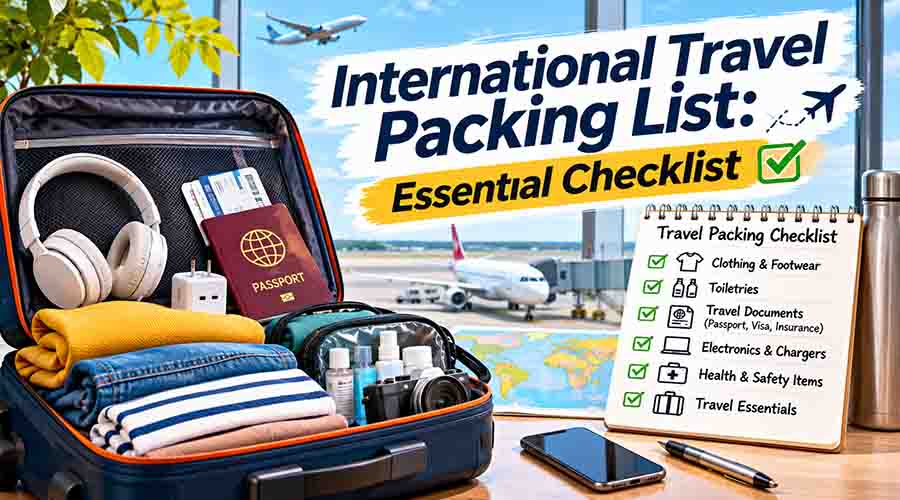
International Travel Packing List: The Essential Checklist
Packing for an international trip is different from packing for a weekend away. Forget a T-shirt and you can buy one anywhere. Forget your passport, pack your power bank in the wrong bag, or bring the wrong plug adapter, and your trip can go wrong before it starts. Crossing a border adds new rules: entry documents, customs restrictions, different plugs and voltages, airline battery limits, foreign currency and medicine laws.
This international travel packing list focuses on what makes overseas trips different. You’ll find what to pack in every category, why each item matters, what to keep in your carry-on, what to leave at home, and a complete checklist to tick off before you leave.
What Should You Pack for International Travel?
Start with your passport, any visa or travel authorization, travel insurance details, payment cards and some local currency, a plug adapter, your phone and charger, medications in their original containers, and copies of key documents. Then add clothing, toiletries and gear based on your destination, climate and activities.
The golden rule is simple: documents, money, medicines and electronics travel with you in your carry-on. Almost everything else can be replaced at your destination if it goes missing.
International Travel Packing List at a Glance
| Category | Essential Items | Why It Matters Abroad |
|---|---|---|
| Documents | Passport, visa or e-visa, tickets, accommodation proof, insurance, copies | Required at check-in, immigration and in emergencies |
| Money | Two payment cards, some local cash, card for foreign transactions | Different currencies, card fees and payment habits |
| Electronics | Phone, chargers, plug adapter, power bank (carry-on only) | Plug types, voltage and airline battery rules differ |
| Health | Medications in original containers, prescription copies, first-aid kit | Medicine laws and availability vary by country |
| Carry-on comfort | Change of clothes, small toiletries, neck pillow, eye mask, earplugs | Long-haul flights and possible delayed bags |
| Clothing | Versatile layers, modest outfit for religious sites, comfortable shoes | Different climates and dress customs |
| Security | Luggage locks, a hidden money pouch, luggage tracker (optional) | Unfamiliar places and lost-bag risks |
Travel Documents: The Non-Negotiables
Documents are the one category you can’t fix after you leave home. Check them first, and check them twice.
Passport
- Validity: Many countries require your passport to be valid for several months beyond your travel dates, often six. Some airlines will refuse to board passengers who don’t meet the rule. Check the requirement for every country on your route, including transit stops.
- Blank pages: Some countries require one or more blank pages for entry stamps or visas.
- Condition: A damaged passport, such as one with water damage or torn pages, can be refused. Replace it before you travel.
Visa or Electronic Travel Authorization
Depending on your nationality and destination, you may need a visa, an e-visa or an electronic travel authorization before you fly. Print a copy of any approval, even if it’s electronic, and keep a screenshot on your phone. Use the Travluno Visa Requirements Checker to organize your research, then confirm on the destination’s official government website. The U.S. Department of State and UK Foreign Travel Advice pages list entry requirements country by country.
Other Documents to Carry
| Document | When You Need It |
|---|---|
| Return or onward ticket | Some countries and airlines ask for proof that you’ll leave |
| Accommodation confirmation | Often requested at immigration |
| Travel insurance policy and emergency number | Medical emergencies, cancellations, lost bags |
| Vaccination certificate | Some countries require proof of certain vaccines, such as yellow fever, depending on your route |
| International Driving Permit | If you plan to drive, in countries that require it |
| Student, work or invitation letters | For study, business or family visits, depending on your visa |
| Emergency contacts | Family, your embassy or consulate, your insurer |
Make Copies, and Store Them Separately
Keep a paper copy of your passport photo page, visa, insurance and tickets in a different bag from the originals. Also store digital copies in secure cloud storage or an encrypted app. If your passport is lost or stolen, copies make replacing it at your embassy much faster.
Money and Payments
What to Bring
- Two payment cards from different networks if possible, such as a Visa and a Mastercard. Keep them in separate places.
- A card with low or no foreign transaction fees. Fees on standard cards can add up over a trip.
- Some local currency for your first day or two, such as transport from the airport, a meal and small purchases.
- A small amount of a widely accepted currency, such as US dollars or euros, as an emergency backup.
Money Tips for International Travel
- Tell your bank and card provider you’re traveling, if they ask for this, so your card isn’t blocked.
- Avoid exchanging money at the last minute. Changing money at the airport or topping up late often means poorer exchange rates or extra charges.
- Pay in the local currency when a card machine asks whether to charge you in your home currency. The conversion rate offered is usually worse.
- Declare large amounts of cash. Many countries require travelers to declare cash above a set amount when entering or leaving. For example, the threshold is $10,000 in the United States and €10,000 in the European Union.
Electronics, Plugs and Power
Plug Adapters vs. Voltage Converters
There are 15 common plug and socket types in the world, labeled A to O. Voltage also varies. Most of the Americas and Japan use around 100–127 volts, while most of Europe, Asia, Africa and Oceania use 220–240 volts.
| Plug Adapter | Voltage Converter | |
|---|---|---|
| What it does | Changes the shape of the plug so it fits the socket | Changes the electrical voltage |
| When you need it | Almost always, when traveling to a country with different sockets | Only for single-voltage devices |
| Typical devices | Phones, laptops, cameras, tablets | Some hair dryers, straighteners, older appliances |
How to check: Look at the small print on each charger or device. If it says “Input: 100–240V, 50/60Hz,” it works worldwide with just a plug adapter. Most modern phone, laptop and camera chargers are dual-voltage. A universal travel adapter with USB ports covers most destinations and lets you charge several devices from one socket.
Electronics Checklist
- Phone and charging cable
- Universal plug adapter (or the specific type for your destination)
- Laptop or tablet and charger, if needed
- Headphones (noise-canceling headphones help on long flights)
- Camera, spare memory cards and batteries
- Power bank
- A short extension lead or multi-USB charger (useful when hotel sockets are scarce)
Power Banks and Spare Batteries: The Rules Have Tightened
The FAA prohibits power banks and spare lithium batteries in checked luggage. They must travel in your carry-on, and you must remove them if your carry-on is checked at the gate. Most airlines worldwide follow the same rule.
Since 2025, many airlines have also restricted using power banks during flights. Emirates, Singapore Airlines, Cathay Pacific, Korean Air and several other Asian and Middle Eastern carriers now ban using or charging power banks on board. Some also limit how many you can carry or their capacity. Check your airline’s current policy before you fly, and fully charge your devices before boarding.
Phone and Internet
- Check that your phone is unlocked if you plan to use a local SIM card.
- Consider an eSIM. If your phone supports one, you can buy a data plan before you leave and connect as soon as you land.
- Compare with your carrier’s roaming plan, which can be convenient but expensive.
Apps and Downloads to Prepare Before You Fly
- Offline maps for each destination
- A translation app, with the offline language pack downloaded
- Your airline’s app and boarding passes
- Ride-hailing and local transport apps used at your destination
- Your banking app, with international access enabled
- Offline copies of bookings and your itinerary
Health and Medications
Traveling Abroad with Medicine
Medicine rules are one of the most overlooked parts of international packing. A medicine that’s common at home may be restricted, or even illegal, in another country. The CDC recommends:
- Keep medicines in their original, labeled containers, with your name, the doctor’s name, the generic and brand names, and the dose.
- Carry a copy of your prescription, and ask your doctor for a letter if you use controlled substances or injectable medicines such as insulin or EpiPens.
- Check whether each medicine is legal at your destination. If it isn’t, talk to your doctor about alternatives before you go.
- Pack enough for the whole trip plus extra days in case of delays, and keep it in your carry-on.
Read the CDC’s guide to traveling abroad with medicine for more detail.
Travel Health Kit
- Pain and fever relief
- Anti-diarrhea medication and oral rehydration salts
- Antihistamines
- Motion sickness tablets
- Adhesive bandages, antiseptic wipes and blister plasters
- Hand sanitizer
- Insect repellent and sunscreen (for warm destinations)
- Spare glasses or contact lenses, plus a copy of your prescription
The CDC recommends seeing a healthcare provider at least 4–6 weeks before an international trip so any vaccines or medicines have time to take effect.
Carry-On Essentials for Long-Haul Flights
International flights are often long, and checked bags sometimes arrive a day or two late. Pack your carry-on so you could manage for 24–48 hours without your suitcase.
Must-haves in your personal bag:
- Passport, visa, tickets and copies
- Wallet, cards and some cash
- Medications and prescription copies
- Phone, chargers, adapter and power bank
- A pen for arrival or customs forms
For comfort on the flight:
- A change of underwear, socks and a T-shirt
- A light sweater or scarf (cabins are often cold)
- Travel-size toiletries: toothbrush, toothpaste, deodorant, face wipes, lip balm, moisturizer
- Neck pillow, eye mask and earplugs
- An empty reusable water bottle to fill after security
- Snacks (but finish or throw away fresh food before customs)
Carry-on liquids: At many airports, liquids, gels and creams in your carry-on must be in containers of 100 ml (3.4 oz) or less, packed in one small clear bag. Medicines and baby food are usually exempt in reasonable amounts. Some airports with newer scanners have relaxed these limits, but rules change, so check your departure and transit airports.
Clothing for International Travel
Pack for Flexibility
- Choose a neutral color palette so every top matches every bottom.
- Layer instead of bulking up: a T-shirt, a long-sleeve top and a light jacket cover most conditions.
- Plan to do laundry on trips longer than a week instead of packing more.
- Bring comfortable, broken-in walking shoes. You’ll walk more than you expect.
Respect Local Dress Customs
Many religious sites, and some entire countries, expect visitors to cover their shoulders and knees. Some places also require you to remove your shoes. Pack at least one outfit with long sleeves and long trousers or a long skirt, plus a light scarf. It takes up little space and saves you from being turned away.
Clothing by Climate
| Climate | Pack More Of | Don’t Forget |
|---|---|---|
| Hot and humid | Breathable cotton or linen, quick-dry fabrics | Hat, sunglasses, light rain jacket |
| Cold | Thermal base layers, fleece, insulated jacket | Gloves, warm hat, waterproof boots |
| Rainy season | Quick-dry clothing | Waterproof jacket, packable umbrella, waterproof shoes |
| Mixed or multi-country | Layers that work together | One warm layer and one rain layer |
Toiletries
- Pack travel-size containers for your carry-on and full sizes in your checked bag.
- Consider solid toiletries (shampoo bars, solid deodorant) to avoid liquid limits and leaks.
- Basic toiletries are easy to buy abroad, so don’t overpack them. Specific brands, prescription skincare and contact lens solution can be harder to find.
- Put liquids in a zip-lock bag inside your checked luggage to prevent spills from pressure changes.
Security and Peace-of-Mind Items
- Luggage locks. If you’re flying to or through the United States, use TSA-approved locks that security can open without breaking them.
- A hidden money pouch or belt for a backup card and cash.
- A luggage tracker (optional). A small Bluetooth tracker in your checked bag helps you locate it if it’s delayed.
- Luggage tags with your phone number and email, and a copy of your contact details inside the bag.
- A photo of your packed suitcase and its contents, which helps with lost-baggage claims.
What Not to Pack for International Travel
| Don’t Pack | Why |
|---|---|
| Power banks or spare lithium batteries in checked bags | Prohibited because of fire risk; carry them on |
| Liquids over 100 ml in your carry-on | Exceed security limits at many airports |
| Fresh food, meat, dairy, seeds or plants | Often restricted by customs and biosecurity rules; some countries have strict fines |
| Medicines not allowed at your destination | Can lead to confiscation, fines or arrest |
| E-cigarettes or vapes, where banned | Some countries, such as Singapore and Thailand, prohibit them |
| Drones (without checking local rules) | Many countries require permits or ban them in certain areas |
| Self-defense sprays, knives or weapons | Prohibited in carry-on and illegal in many countries |
| Expensive jewelry and unnecessary valuables | Theft and loss risk |
| Too many “just in case” items | Most everyday items can be bought abroad |
When in doubt, check your destination’s customs website and your government’s travel advice page for local laws.
Carry-On vs. Checked Bag: International Edition
| Carry-On or Personal Bag | Checked Bag |
|---|---|
| Passport, visa, tickets, copies | Most clothing and shoes |
| Wallet, cards, cash | Full-size toiletries |
| Medications and prescriptions | Extra adapters and cables (not batteries) |
| Phone, laptop, chargers | Gifts (unwrapped, in case of inspection) |
| Power banks and spare batteries (required) | Bulky jackets and gear |
| Change of clothes and small toiletries | Snacks and items to declare at customs, packed so they’re easy to reach |
| Valuables, jewelry, keys | Liquids over 100 ml |
International Packing Timeline
| When | What to Do |
|---|---|
| 6–8 weeks before | Check passport validity and visa rules. Book a travel health appointment. Check medicine rules at your destination. |
| 2–4 weeks before | Buy adapters, a power bank and any missing gear. Arrange an eSIM or SIM plan. Order some local currency if needed. |
| 1 week before | Check your airline’s baggage and battery policy. Make copies of documents. Download offline maps and apps. Start packing. |
| 48 hours before | Check in online. Weigh your bags. Charge every device. Confirm documents are in your carry-on. |
To keep everything in one place, plan your days with our travel itinerary template, estimate total costs with the Trip Cost Calculator, and create a tailored list with the Travel Packing List Generator. For general packing basics like clothing counts, folding methods and family packing, see our Ultimate Travel Packing List.
Complete International Travel Packing Checklist
Documents
- Passport (valid for the required period, with blank pages)
- Visa, e-visa or travel authorization (printed and digital)
- Return or onward ticket
- Accommodation confirmations
- Travel insurance policy and emergency number
- Vaccination certificate (if required)
- International Driving Permit (if driving)
- Paper and digital copies of all documents
- Emergency contacts and embassy details
Money
- Two payment cards, stored separately
- Card with low foreign transaction fees
- Some local currency
- Emergency backup cash
Electronics
- Phone and cable
- Universal plug adapter
- Voltage converter (only for single-voltage devices)
- Power bank (carry-on only)
- Laptop or tablet and charger
- Headphones
- eSIM or SIM plan arranged
- Offline maps and translation app downloaded
Health
- Medications in original containers
- Prescription copies and doctor’s letter (if needed)
- Travel health kit
- Spare glasses or contacts
Carry-on comfort
- Change of clothes
- Travel-size toiletries (100 ml or less)
- Neck pillow, eye mask, earplugs
- Empty water bottle
- Pen for arrival forms
Clothing and toiletries
- Versatile, layerable outfits
- One modest outfit and a scarf
- Comfortable walking shoes
- Weather-appropriate layers
- Toiletries (full size in checked bag)
Security
- Luggage locks
- Hidden money pouch
- Luggage tags and contact details inside bags
- Luggage tracker (optional)
Frequently Asked Questions
What should I pack for international travel?
Start with your passport, any visa or travel authorization, travel insurance details, payment cards and some local currency, a plug adapter, your phone and charger, medications in their original containers, and copies of key documents. Then add clothing, toiletries and gear based on your destination, climate and activities.
What documents do I need for international travel?
Most travelers need a valid passport and, depending on nationality and destination, a visa or electronic travel authorization. Also carry your return or onward ticket, accommodation details, travel insurance information and, where required, a vaccination certificate. Keep paper and digital copies separate from the originals.
Do I need a plug adapter or a voltage converter?
A plug adapter only changes the shape of the plug. A voltage converter changes the electrical voltage. Most phone, laptop and camera chargers accept 100–240 V and need only an adapter. Check the label on each device, because single-voltage items such as some hair dryers may need a converter.
Can I take my medications abroad?
Usually yes, but rules vary by country. Keep medicines in their original labeled containers, carry a copy of your prescription, and ask your doctor for a letter for controlled substances or injectable medicines. Check that each medicine is legal at your destination before you travel.
Can I bring a power bank on an international flight?
Yes, but only in your carry-on bag, never in checked luggage. Many airlines also limit the number or capacity of power banks, and several now ban using or charging them during the flight, so check your airline’s current policy.
How much cash should I bring when traveling abroad?
Bring enough local currency for your first day or two, such as transport from the airport, a meal and small purchases, and rely on cards and ATMs for the rest. Many countries require you to declare cash above a set amount when you enter or leave.
What should I not pack for international travel?
Do not pack spare lithium batteries or power banks in checked bags, liquids over 100 ml in your carry-on, or fresh food, meat, dairy and plants that may be restricted at customs. Avoid anything illegal at your destination, such as certain medicines or, in some countries, e-cigarettes. Leave unnecessary valuables at home.
Conclusion: Pack the Essentials, Then Travel Light
A good international travel packing list isn’t about bringing more. It’s about bringing the right things and putting them in the right bag. Get your documents, money, medicines and electronics right, keep them in your carry-on, and check the few rules that change from country to country: entry requirements, plug types, battery limits, medicine laws and customs restrictions. Almost everything else can be bought when you arrive.
Ready to pack? Generate a personalized checklist with the free Travel Packing List Generator, check your entry requirements with the Visa Requirements Checker, and ask experienced travelers about your destination on the Travluno Travel Forum.

Travluno
Travluno shares practical travel guides, destination ideas and tips to help travelers explore with confidence.